
How to Reduce No-Shows and Late Cancellations at Your Music School
A single weekly student who quietly drifts away costs a small studio hundreds of dollars a year. Multiply that across a roster and no-shows become the difference between a school that grows and one that just treads water. The good news: most missed lessons are preventable with a system — not more nagging.
1. Understand why students vanish
No-shows are rarely about the music. They're about friction and forgetfulness: a parent lost track of the time, a teenager had an exam, a payment lapsed and nobody noticed, or a string of "just this once" reschedules slowly turned into quitting. Each of these has a fix, and none of them is "send an angrier email."
2. Send automatic reminders
The single highest-return change you can make is an automated lesson reminder the day before. When students and parents get a nudge without you lifting a finger, attendance climbs immediately. The key word is automatic — a reminder you have to remember to send is one you'll skip on your busiest weeks, which are exactly the weeks it matters most.
3. Make rescheduling easy — but bounded
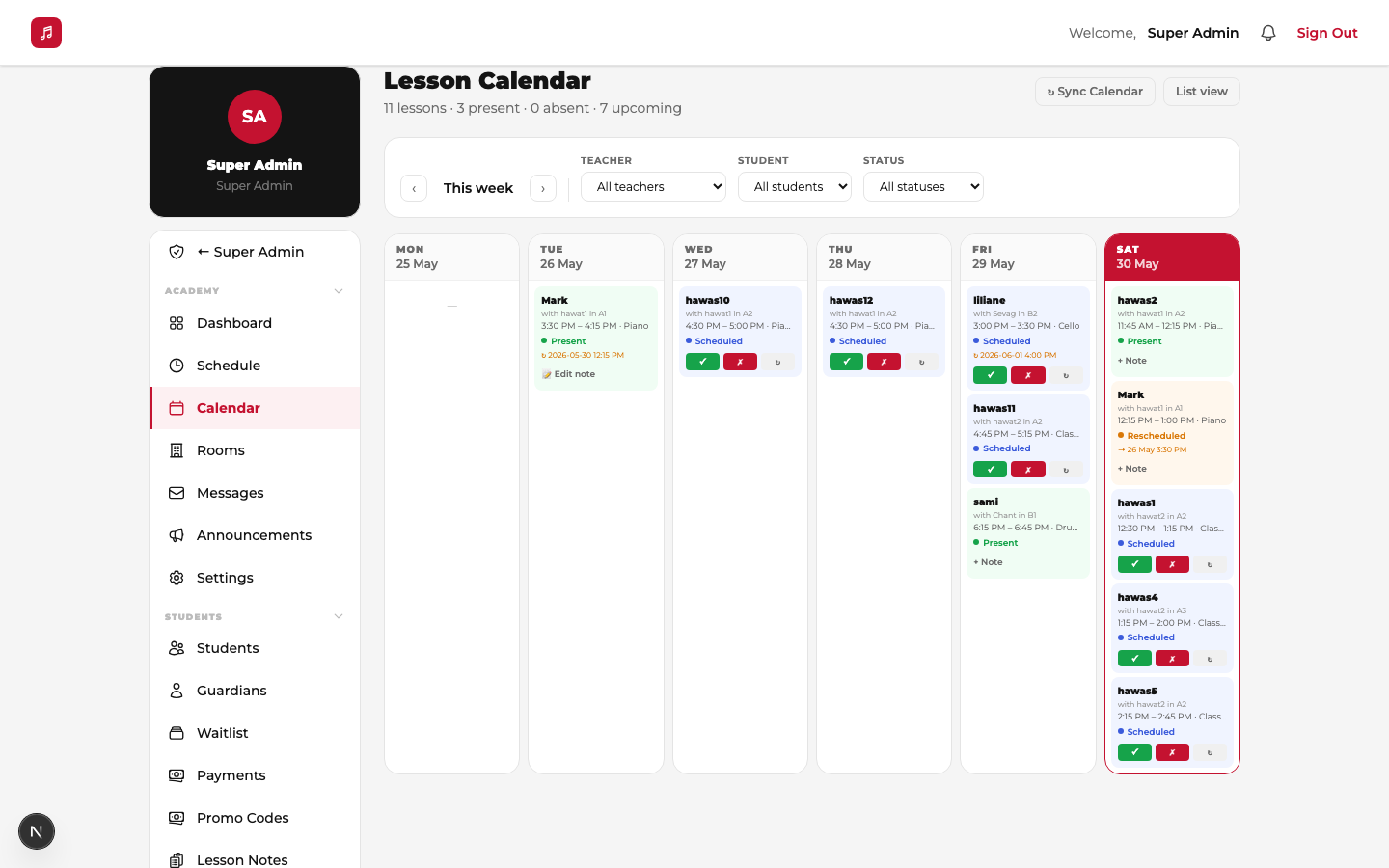
Counterintuitively, a clear reschedule policy reduces cancellations. When students know they get, say, one make-up per month, they treat their slot as valuable rather than disposable. When rescheduling is a free-for-all, every lesson becomes negotiable. Set a limit, make it visible, and let students request a make-up through their own login instead of texting you at 9pm.
4. Track attendance every single lesson
You can't fix what you don't measure. Marking each student present, absent, late, or rescheduled turns vague gut feeling ("I think Sarah's been flaky lately") into a number you can act on before she quits. Attendance data also protects your revenue: it feeds billing, make-up credits, and parent reports automatically. Skipping it is the most common reason schools lose money without knowing why — the same point we make in our billing guide.
5. Catch the warning signs early
Two missed lessons in a row is a flashing red light. A student whose payment has lapsed is another. The schools with the best retention aren't the ones with the strictest rules — they're the ones that notice early and reach out warmly before a student has mentally checked out. Flagging at-risk students automatically means you act in week two, not month three.
6. Keep parents in the loop
For younger students, the parent is your real customer. A parent who can see that their child attended, what they practised, and what's coming up stays engaged — and an engaged parent keeps the lessons on the calendar. This is also why word-of-mouth growth follows good retention: happy, informed parents refer other parents.
Put it on autopilot
Spoteca handles the whole loop — automatic lesson reminders, a built-in reschedule policy, one-tap attendance, at-risk student flags, and a parent portal — so retention stops depending on your memory. It's all in one place, free for up to 10 active students. Create your school in minutes.
Run your music school without the chaos
Free forever for up to 10 active students. No credit card required.
Get Started Free