The Admin Guide
You run the school day-to-day: teachers, students, the schedule, payments and communication. This guide follows the exact order that gets a school running — Teachers → Availability → Students → Schedule — then covers every tool you'll use daily.
10 · Programs
Sidebar → Lessons → Programs
A program is something you sell: several lessons for one price. "The Singing Pianist" might be 8 piano lessons, 4 vocal lessons and a term in the choir — one figure the family pays, whatever it contains.
Building one
Name it, choose a Program price plan (create one in School Settings → Pricing Plans — it may be charged as one total or per term, never monthly), then add what it includes:
- An individual lesson — subject, length, how many a week, how many in total, and what the teacher is paid for it. The count is required: a program is paid once, so a lesson with no end would run for ever against a price already collected.
- A group class — pick one that already runs. You may leave its count blank; the class keeps its own schedule and pays its own teacher.
At the bottom, the economics: revenue, what the individual lessons cost you, and what the group classes cost. The group line does not multiply — you pay the choir's teacher once however many program students join it, which is why the fifth student is worth more than the first.
Enrolling a student
Open the program's roster and add a student with their own start date. For each individual lesson choose the teacher and either a weekly slot or pick the dates by hand; group classes need nothing, they are simply joined. Spoteca checks the lot before saving anything — the student's own lessons, the teachers', the rooms, the classes, and the program's items against each other.
Cancelling a place
Cancel on a roster row shows what has not been delivered — item by item — and suggests refunding that share of the price. The number is a suggestion; you confirm it. Lessons still to come are removed, class memberships end today, and the teacher's unpaid bills can be cancelled with it. Attendance and notes already recorded are kept.
The setup order (why it matters)
| # | Step | Why it can't be skipped |
|---|---|---|
| 0 | Super Admin created a pricing plan | Enrollment requires a plan. If none exists, ask your Super Admin — see the Super Admin guide. |
| 1 | Configure subjects & rooms | Teachers and enrollments are organised by subject; lessons can be assigned to rooms. |
| 2 | Add teachers | A lesson always belongs to a teacher. |
| 3 | Teachers set availability | You cannot book a slot the system doesn't know is free. |
| 4 | Enroll students | Enrollment = student + subject + teacher + slot + plan. Everything downstream (schedule, payments, attendance) flows from it. |
1 · Settings: subjects & policies
Sidebar → Settings
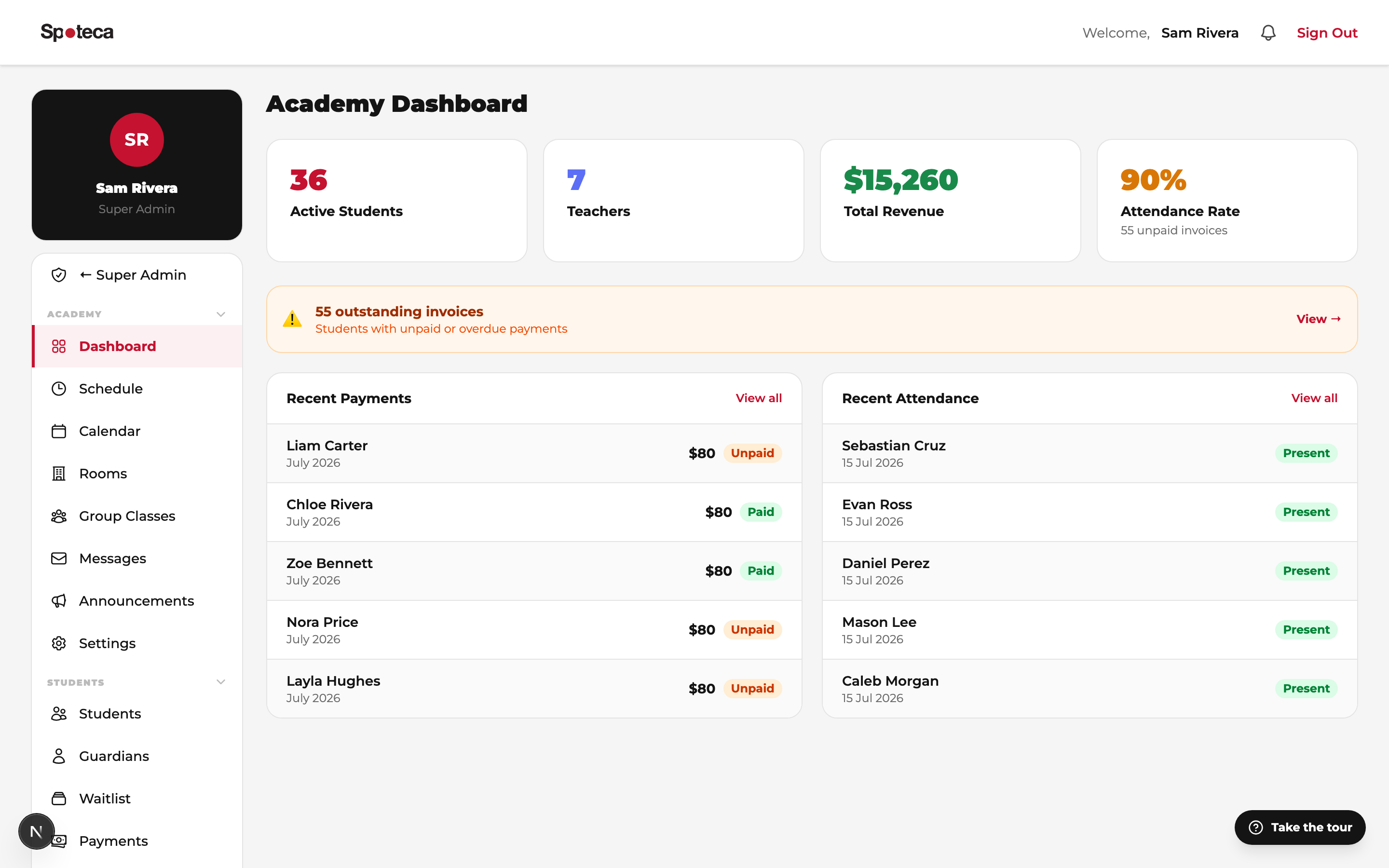
The Subjects Offered list — the subjects your school teaches (Piano, Ballet, Karate, English…) — appears everywhere: teacher profiles, enrollment forms, the curriculum, the public join page. It starts empty for a new school, and it's managed by the school owner under Super Admin → School Settings → Subjects tab. If the owner enables "Allow Admins to Manage Subjects" in their Preferences, you can add and edit subjects right here in Settings too. This page also holds your studio rooms and school policies.
2 · Rooms
Sidebar → Calendar → Rooms
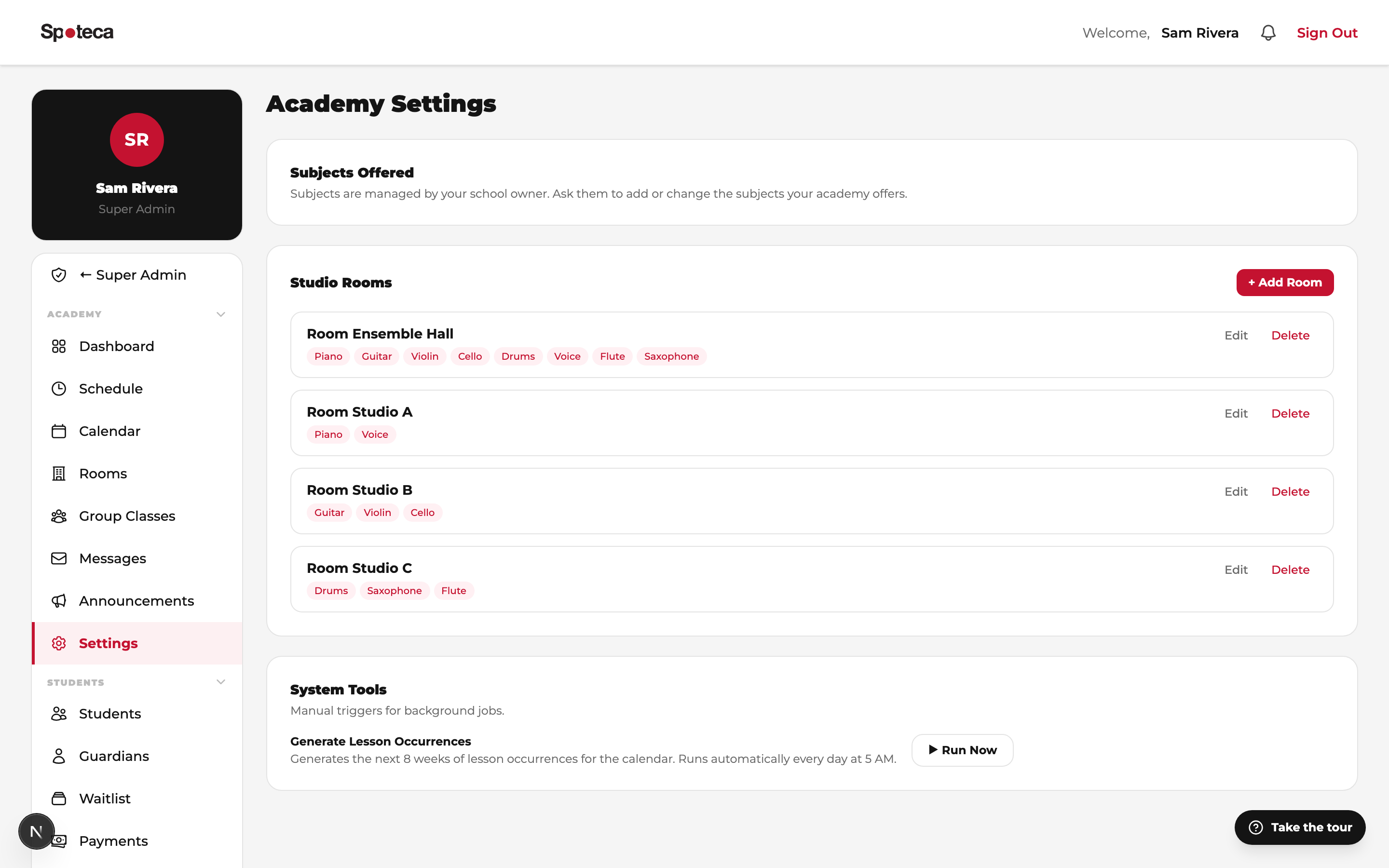
Add each physical room with a name and the subjects it's compatible with (the drum room isn't for violin lessons). Mark rooms that allow group classes and set their capacity. When scheduling, Spoteca only offers compatible, free rooms — and guarantees no two lessons ever share a room at the same time.
3 · Add teachers
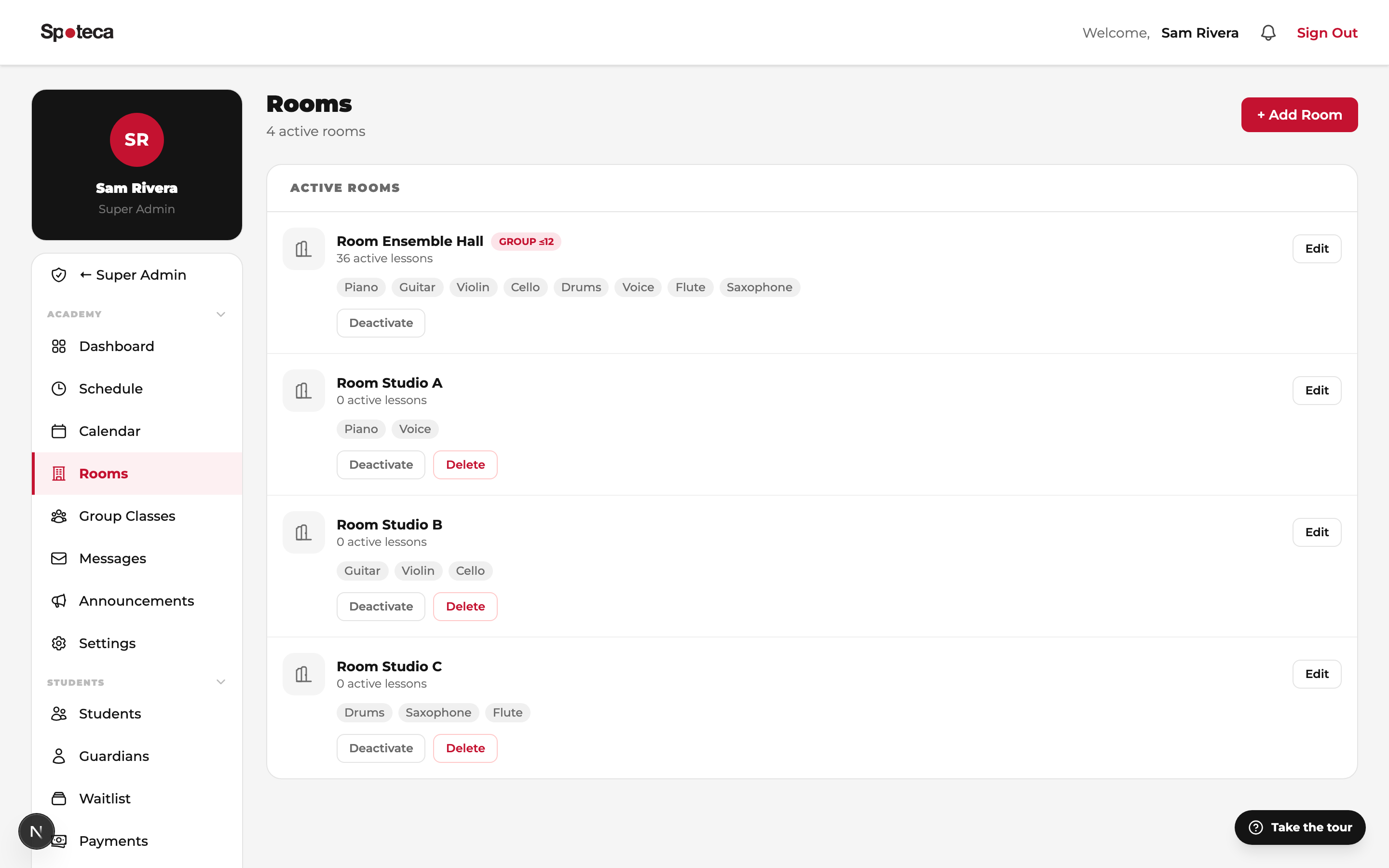
Sidebar → Teachers → Teachers → + Add Teacher
Identity & login — all required
Full name, a username (what the teacher signs in with), a password (min. 6 characters — the teacher can change it later), email, phone number and whether that number has WhatsApp. A profile photo is required too (JPG/PNG, max 600×600) — it appears on schedules and the student's "My Teacher" page.
Subjects — at least one
Tap every subject the teacher covers. This filters which teachers appear when you enroll a student for that subject.
Bio & CV (optional)
A short bio (visible to students) and a CV file.
Hand the teacher their username + password and point them to the Teacher guide. Their first job is the next section.
4 · Teacher availability — the critical step
There are three ways to get availability into the system — pick per teacher:
Option A — You set it for them (fastest)
Sidebar → Teachers → the green Availability button on a teacher's card. The same weekly grid the teacher sees opens in a window: click or drag to paint the hours they can work, then Save availability. No waiting for anyone to log in.
- Lessons already booked show red and can't be unpainted — cancel or reschedule the lesson first.
- The teacher is notified every time you change their hours, so nothing moves under them silently.
- If your school runs fixed hours, hit Import school hours first and adjust from there instead of painting a whole week.
Option B — Teachers set their own hours (freelance-style)
Each teacher logs in with the credentials you created, opens My Schedule → My Availability, and paints the hours they can teach (click or drag on the weekly grid, 15-minute precision, then Save availability). They have the same Import school hours button. Full walkthrough with screenshots in the Teacher guide.
Option C — Bulk import from a spreadsheet
For a whole roster at once, the Super Admin imports an Excel availability sheet — one row per teacher / day / 15-minute slot. See Import Data for the exact format. Teachers can still refine their grid afterwards.
5 · Add & enroll students
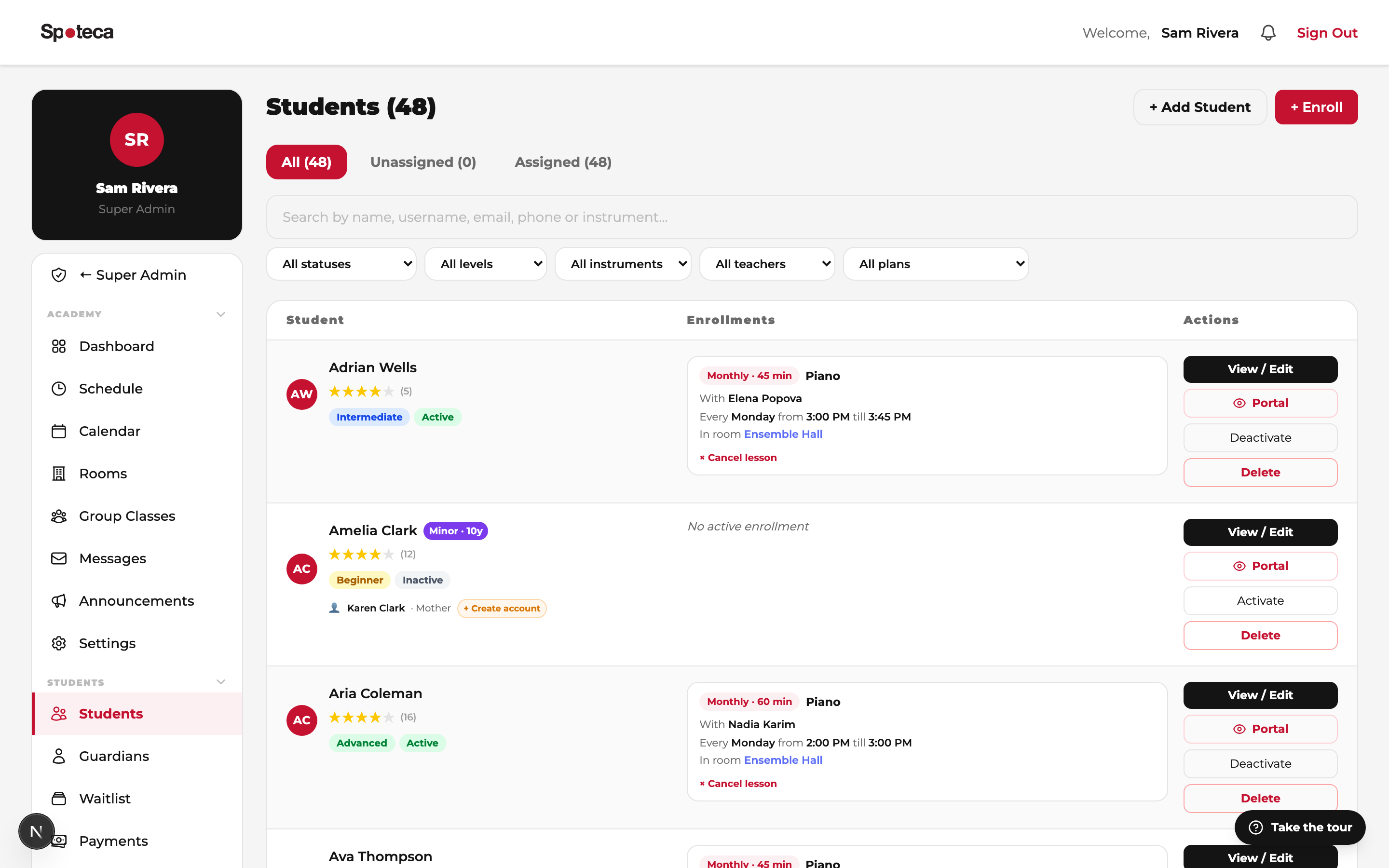
Sidebar → Students → Students
Two buttons, two purposes:
- + Add Student — creates a student profile only (no lessons yet). Use for waitlisted kids or imports.
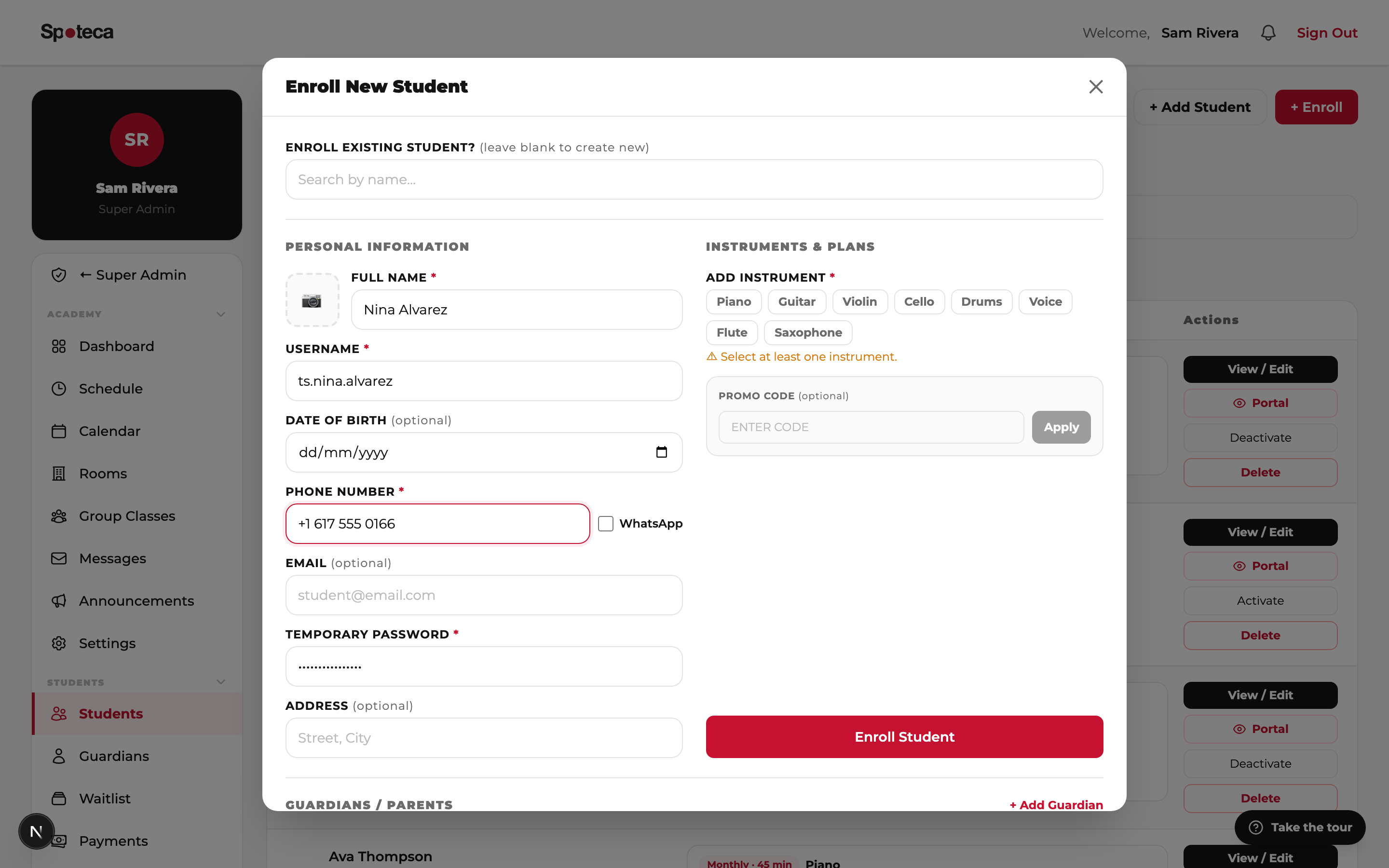
- + Enroll — the full flow: creates the student (or picks an existing one) and their enrollment with teacher, weekly slot and pricing plan. This is your everyday button.
The Enroll flow, step by step
Student details
Name, username + temporary password (their login) and phone number are required; date of birth, email and address are optional. Existing student? Search by name instead. Enrolling a minor? At least one guardian (parent) must be added in the Guardians section of the same form.
Subject
Choose from your school's subject list. A student can hold several enrollments (piano and guitar), each with its own teacher, slot and plan.
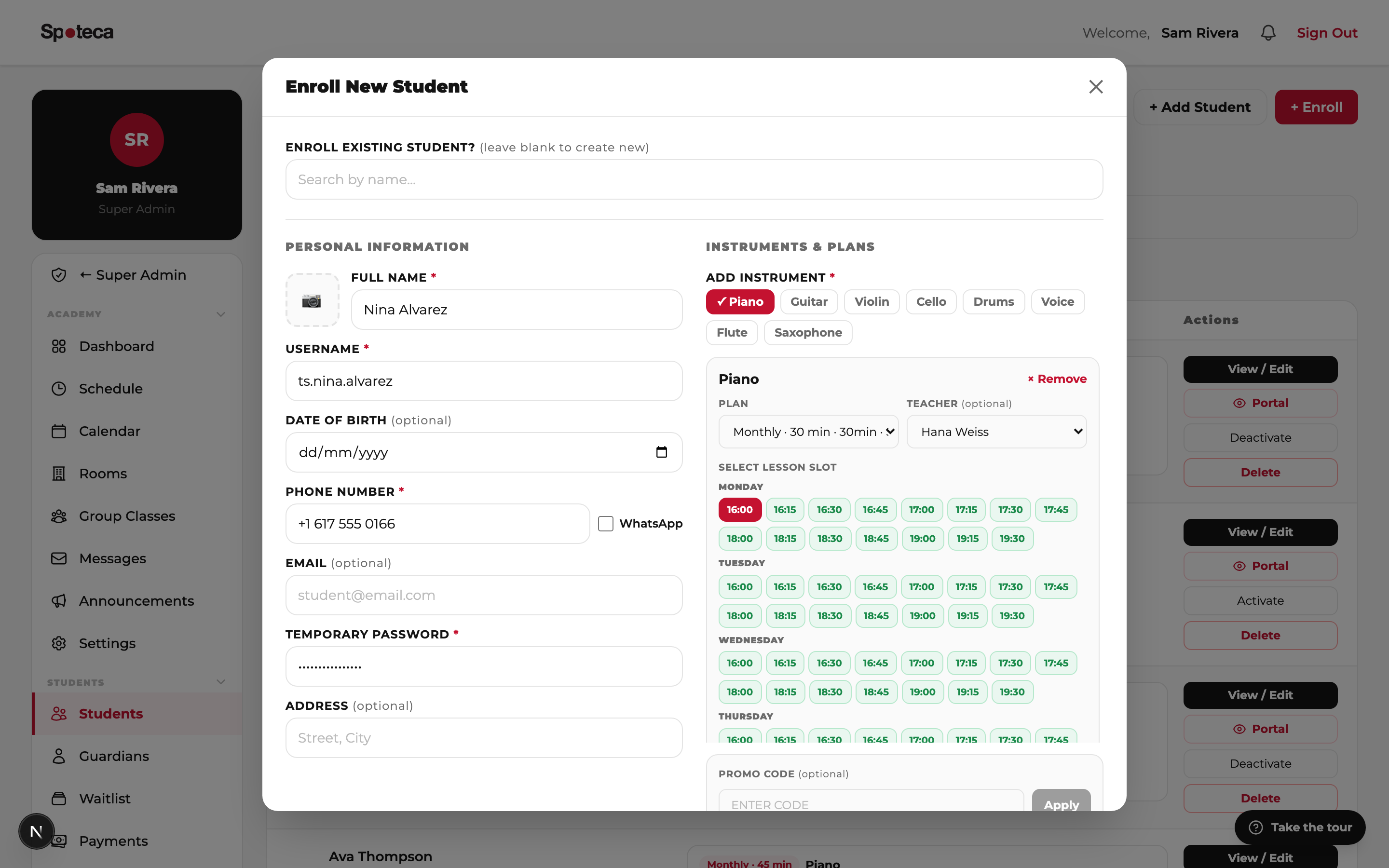
Teacher & slot
Spoteca lists only teachers who teach that subject, then only their free, available slots (teacher availability minus existing bookings). Pick the weekly day + time. A compatible free room can be assigned in the same breath. If the chosen plan includes 2+ lessons per week (intensive), the form asks you to pick each additional weekly slot with the same teacher.
Pricing plan
Choose one of your school's plans. The plan drives everything financial: invoice amount and cycle, teacher pay, reschedule allowance.
Confirm
Click Enroll Student. Spoteca instantly creates the weekly recurring lesson, generates the first payment, and (if enabled) notifies the teacher.
Student profiles
Open any student for the full picture: enrollments, lessons, attendance, payments, notes, guardians, and extended fields (emergency contact, medical notes, referral source, tags…). Your school can even define custom fields that appear on every student form.
🔒 Private staff notes. The student page has a confidential Private staff notes section, visible to school staff only — never the student or guardians. You see every note any teacher has written about the student, and can add your own. Teachers see only their own notes; super-admins can remove any note.
When a student stops
Use Deactivate on the student. Billing stops, their history — lessons, attendance, notes, invoices — stays, and you can reactivate them later. Permanently deleting a student is reserved for the school owner and is meant for accounts created by mistake: it is refused if the student was ever enrolled or invoiced, because an invoice is a record that can only be cancelled, never erased.
Two or three lessons a week? On the weekly option, a pack counts every weekly slot together: a 5-session pack on Monday and Thursday is Mon, Thu, Mon, Thu, Mon — and stops there.
6 · The public enrollment link
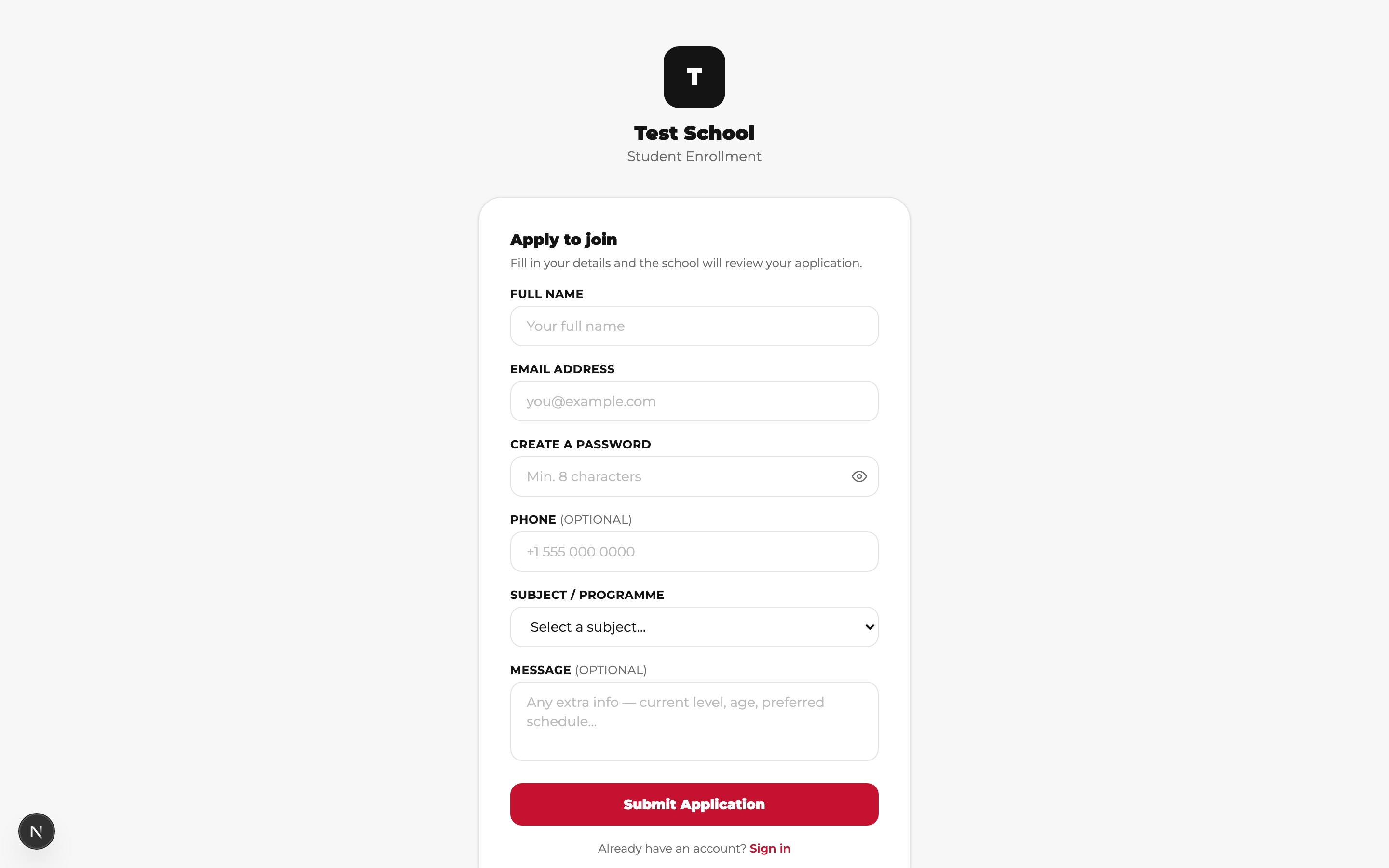
First, the Super Admin enables it: School Settings → Self-Enrollment (Public Signup) — the toggle reveals your copyable join link and a ready-made QR code. Then share spoteca.com/join/yourschool on WhatsApp, Instagram or your website. Prospects create their own student account (name, email, password, phone, subject of interest, message) and land in your pending students — you complete the enrollment when they're ready. It's your always-on lead-capture page, branded with your logo.
7 · Schedule & calendar
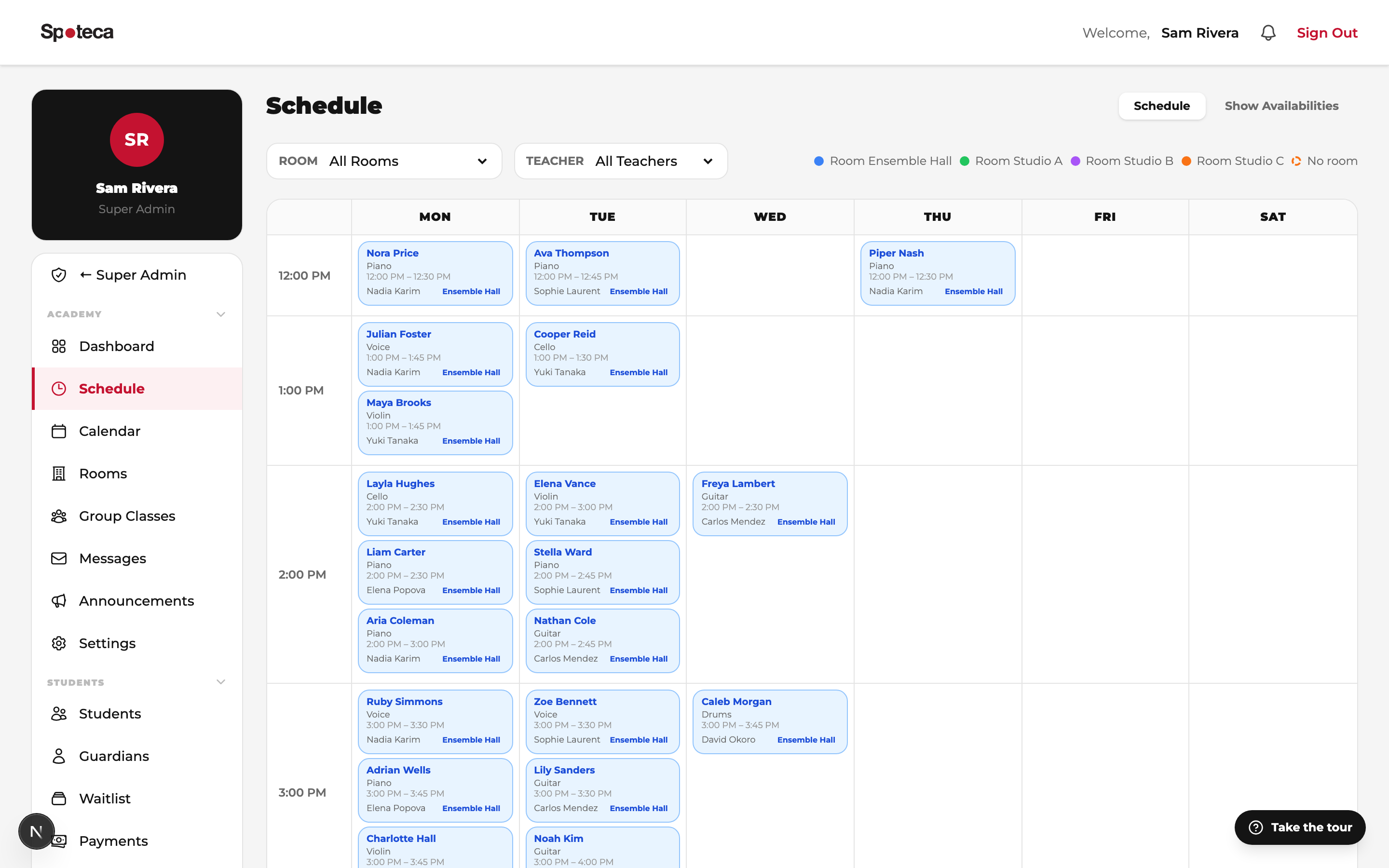
Sidebar → Calendar → Schedule — the weekly grid across all teachers. It shows every teacher's availability and bookings side by side:
Click any green slot to enroll a student straight into it — the enroll form opens with teacher, day and time pre-filled. This is the fastest way to fill your week.
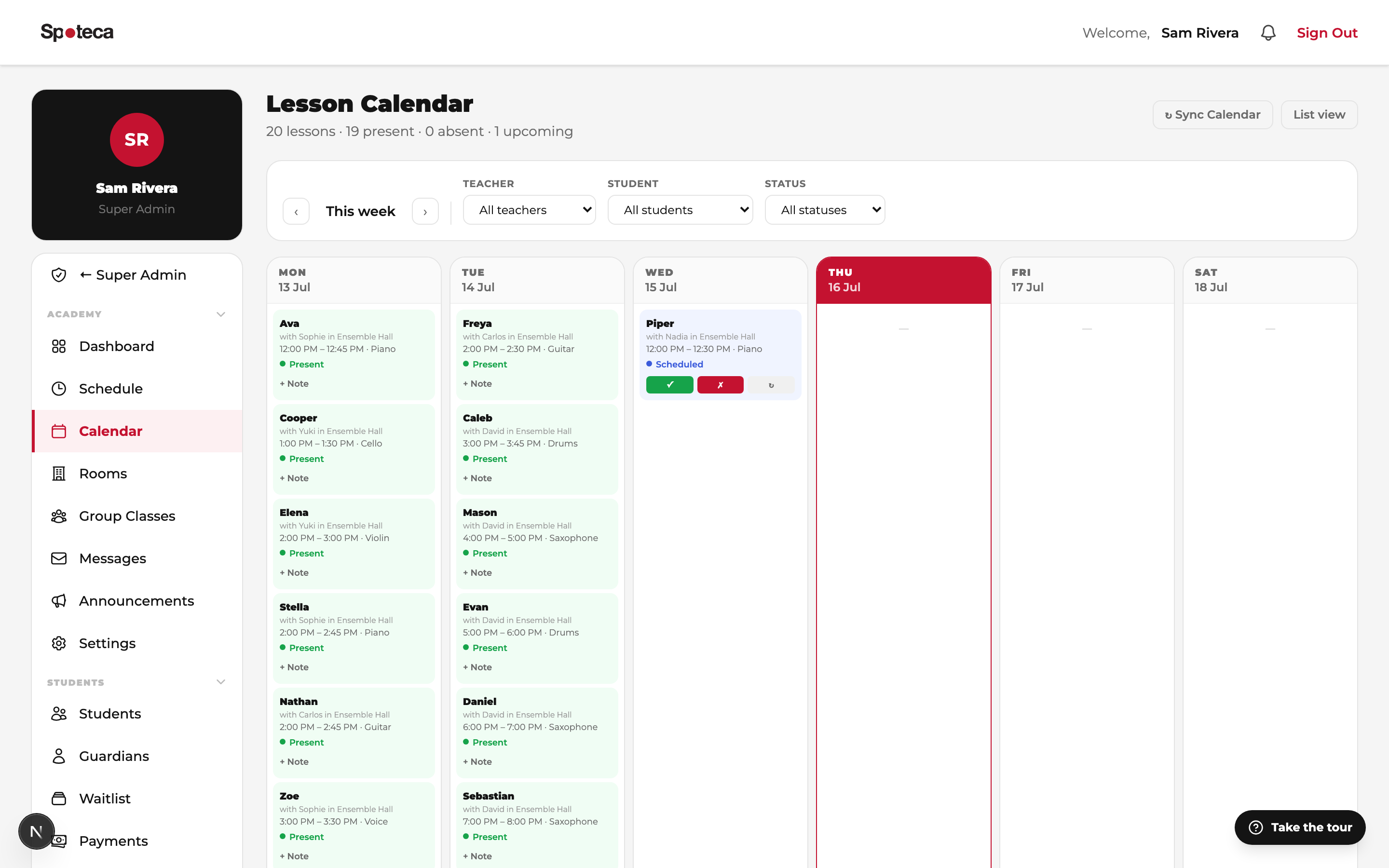
Sidebar → Calendar — the date-based view: every lesson occurrence on real dates, including one-time events, group sessions and reschedules. Rooms can be assigned from here too.
8 · Reschedules, cancellations, absences & closures
Reschedule requests from families
When your owner has switched on student reschedule requests (Preferences), a student — or a parent, for their child — asks from their own Schedule page. They choose the lesson, then pick from times the teacher is actually free; the room is left to you. Every admin is notified and you approve or refuse the request.
- The allowance is per subject. The plan sets how many reschedules a month the family may use, and a student with piano and guitar has a separate allowance for each. Families see how many they have left on their dashboard and Schedule.
- Who asked decides who pays for it. A move the family asked for uses one of their reschedules. A move the school makes — a teacher is ill, a room is double-booked — is free.
- Moved to another day leaves an orange card on the old date, with an arrow to where the lesson went; the new date carries ↻ Moved from…. Moved to another hour on the same day changes that lesson in place — there is no second card — and the card says ↻ Moved from 2:30 PM, so the old time is never lost.
- Permanent moves rewrite the weekly slot itself. On a session pack, a permanent move shifts the sessions still to come rather than rebuilding the pack.
- Hand-picked packs have no weekly slot. Click any of the pack's sessions → Reschedule → Re-pick the remaining dates to choose new dates for every session not yet marked — including ones that went by with no register taken. If those did happen, mark them on the calendar instead.
Cancelling a lesson — and the notice window
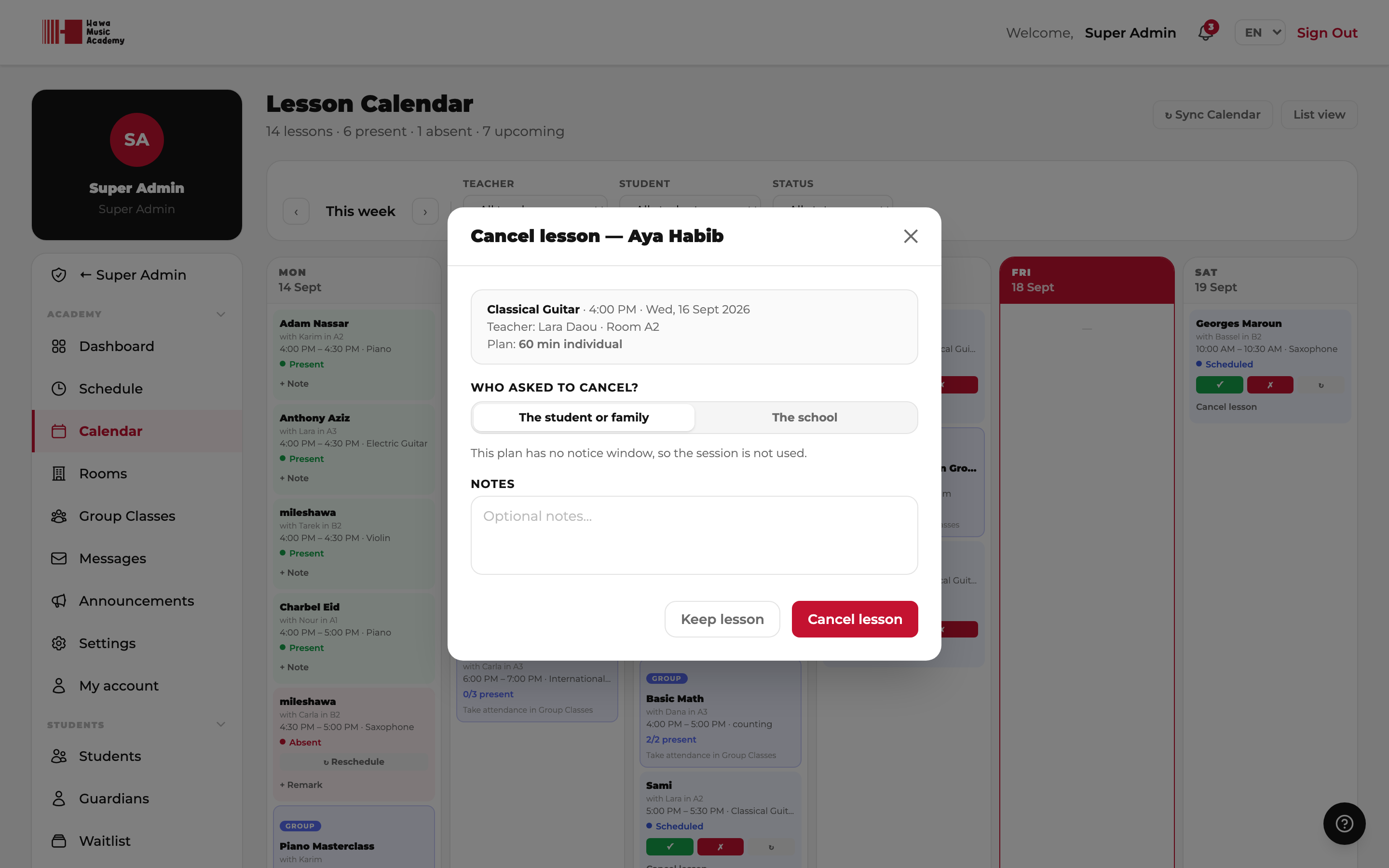
On the Calendar, open a lesson and choose Cancel lesson. Spoteca asks who asked to cancel:
- The school — the session is not used. The student keeps it.
- The student or family — it depends on the plan's cancellation notice. With enough notice, the session is not used. With less notice than the plan asks for, it counts as used, like a no-show — and you can tick Waive it when you want to be kind. A late cancel shows on the lesson as counted or waived, and you can change your mind later.
The notice window is set per plan by the owner and is off by default. When it is on, families also can't ask to move a lesson that starts sooner than the window — unless the owner allows late requests on that plan.
Teacher absences
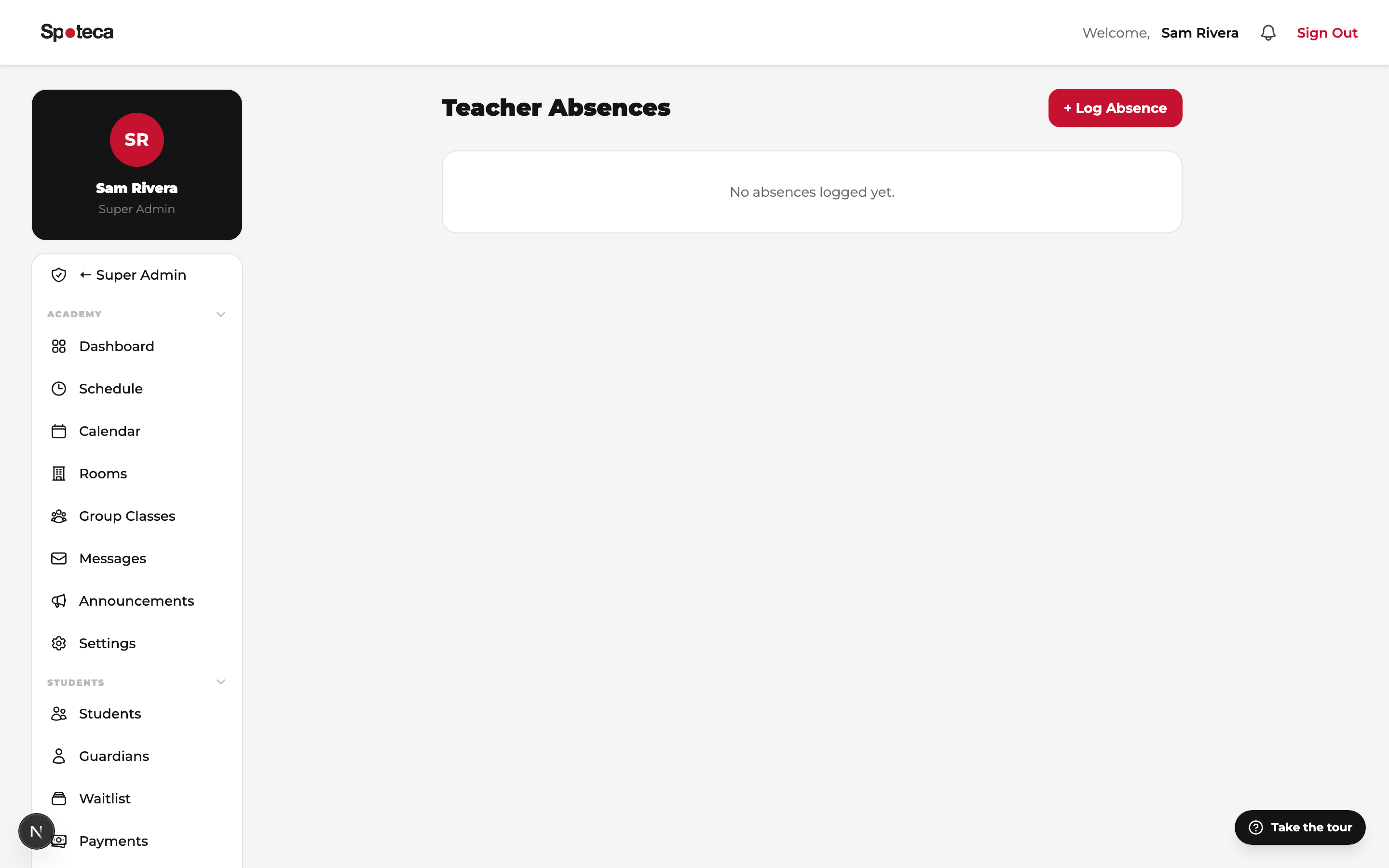
Sidebar → Teachers → Absences — log sick days, vacation or personal leave for a date range. Spoteca finds every affected lesson and walks you through rescheduling each one into a free slot; a replacement lesson can be moved again later from the absence itself. If no slot works, issue a refund — cash, or credit automatically applied against the student's next invoice.
Academy closures
Holidays close the whole school for a date: every teacher is marked absent and all lessons that day are handled the same way (reschedule or credit). Single closed dates are set by the owner under School Settings → Closed Days.
9 · Group classes & events
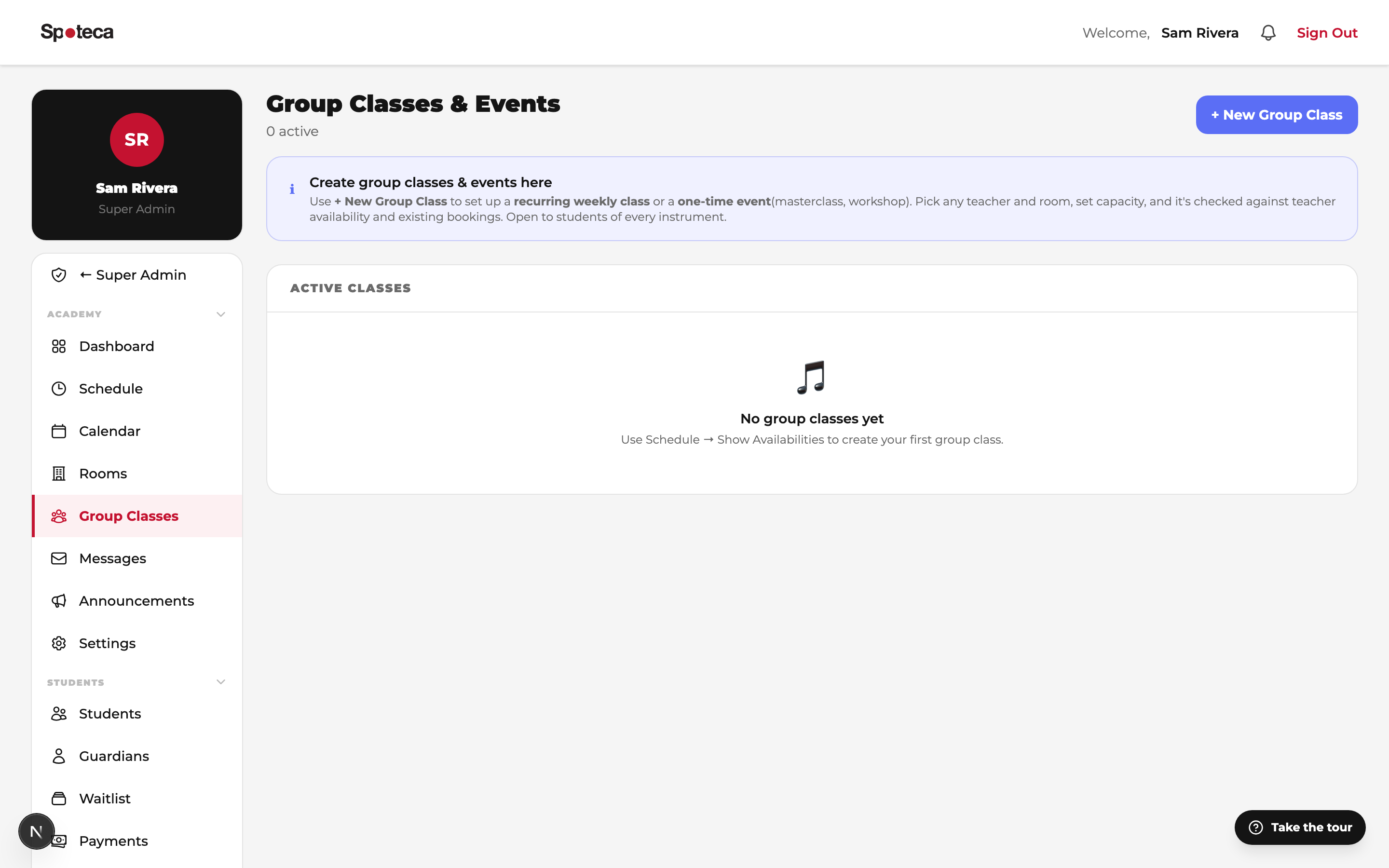
Sidebar → Lessons → Group Classes
Theory circles, ensembles, workshops: pick a teacher, room, weekly day/time (or a one-time date for events/recitals), a group pricing plan, and enroll multiple students. Group extras:
- Capacity — cap the class size; full classes can feed the waitlist.
- Minimum students to start billing — don't charge anyone until the class is viable (you can override and start billing manually).
- Per-session attendance — each session tracks attendance per student.
- Session packs on your own dates — choose Schedule N sessions when a prepaid pack does not run weekly. Pick a prepaid (bundle) plan and the picker shows exactly as many rows as the plan sells: one date and time per session, so a pack can run Fri 4pm, then Wed 5pm, then skip a month. Fill weekly from the first date sets a weekly pattern in one click if that is what you want, and you then change only the sessions that differ. Each time is picked from the teacher's availability on that date, with their existing lessons greyed out and school closures flagged. A pack on your own dates does not auto-renew — when the sessions run out, you set up the next pack yourself.
- One-time events — set a date instead of a weekly day for recitals, masterclasses, open days. Pick the date first, then choose the time from the teacher's availability on that date: times they are already teaching are greyed out, and closure days are flagged, so you see a clash before you save.
A class that meets more than once a week
Dance, martial arts, gymnastics and ensemble programmes are usually sold twice or three times a week. You do not make one class per weekday — that double-bills every student and splits the register in two.
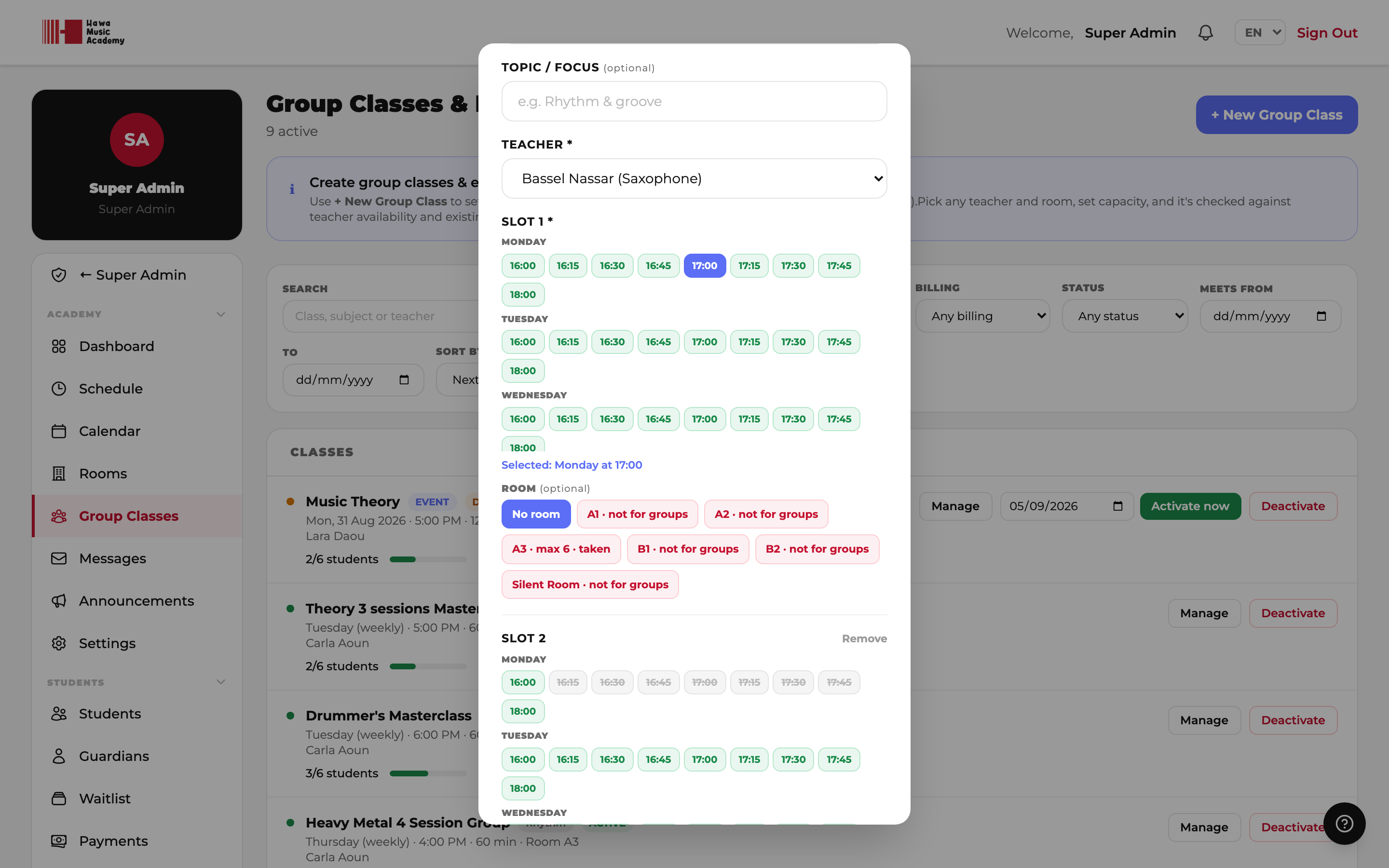
Instead, set up Slot 1 — day, time and room — then press + Add another slot for the second weekly meeting, and again for a third. There is no limit.
- Two sittings on one day are allowed. A class can meet on as many weekdays as you like, and twice on the same one — Tuesday 4pm and Tuesday 6pm are two sittings, each with its own register, notes and attendance. Only the same day at the same time is refused, because that is one meeting entered twice.
- Each slot has its own day, its own time and its own room. Tuesday 5pm in the big studio and Thursday 6:30pm in the small one is a single class, not two.
- Times come from the teacher's availability for that day — the same picker as slot 1, not a free-text box. Slots they are already teaching are greyed out.
- Rooms are shown free or taken at that slot's own day and time, exactly as when you book an individual lesson. You choose from what is actually free instead of discovering the clash later.
Everything downstream counts every slot: the register, the calendar, the number of sessions on the invoice, and the teacher's per-lesson pay. A twice-a-week class holds twice as many sessions in a month and is priced and paid accordingly.
Draft → Activate: nothing bills until you say so
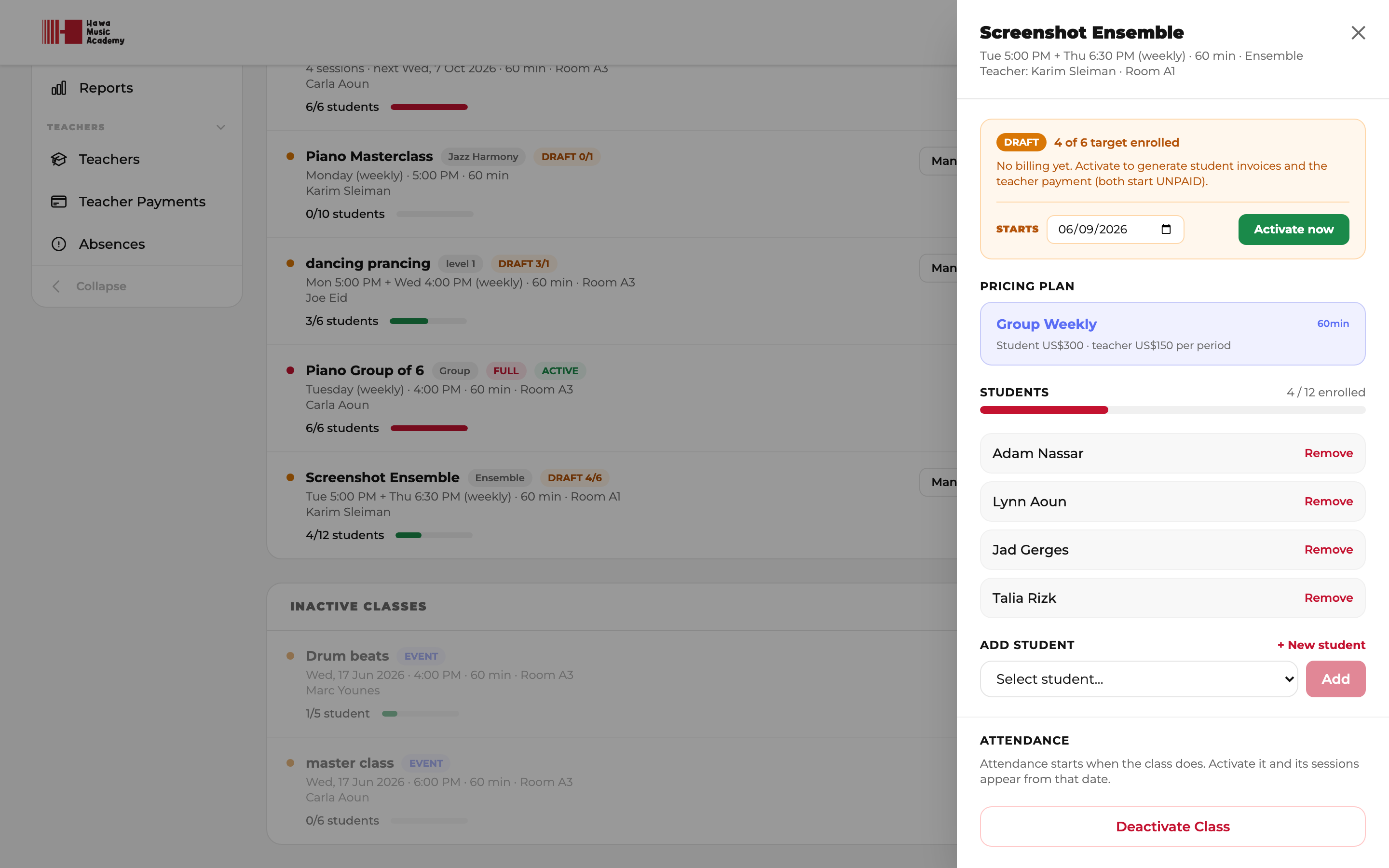
A new group class is created as a DRAFT. A draft charges nobody — no student invoice, no teacher payment — and has no attendance register at all. That is deliberate: a class that has not started has no sessions to mark, and an empty register invited people to take attendance for a class that did not exist yet.
Enrol your students, then activate. The banner on the class carries a start date and a button:
- Leave the date as today and the button reads Activate now.
- Set a future date — the first Monday of next term, say — and the button names it: Activate from 12 Oct. Same action, later start.
Minimum students is only a warning here. Activate with fewer students than the minimum and Spoteca tells you how many are enrolled and asks whether to go ahead. It never refuses silently, and it never starts billing on its own.
What activation actually does
Three things, all dated from the start date you chose:
- The register begins. Sessions are listed from the start date forward, one row per weekly meeting per slot, each at that slot's own time. Nothing before the start date appears — a class starting next Monday does not collect a fortnight of empty sessions behind it.
- Student invoices are raised, one per enrolled student, status UNPAID.
- The teacher's payment is raised, status UNPAID, following the plan's rate basis — or nothing upfront if the teacher is paid only for attended sessions.
Which period gets billed depends on the plan:
| Plan type | What the start date bills |
|---|---|
| Monthly / recurring | The month the class actually starts. Activating in September for an October start raises an October invoice, not a September one. A mid-month start counts only the meetings from that day onward in the first month; every month after is a whole month. |
| Per Term | The term containing the start date, prorated to the sessions left in it. If the plan has auto-renew ON, it is re-billed every following term. |
| Session pack | The pack's sessions are generated from the start date forward. |
Marking those invoices paid is the normal Payments / Teacher payments job.
Handing a class to another teacher
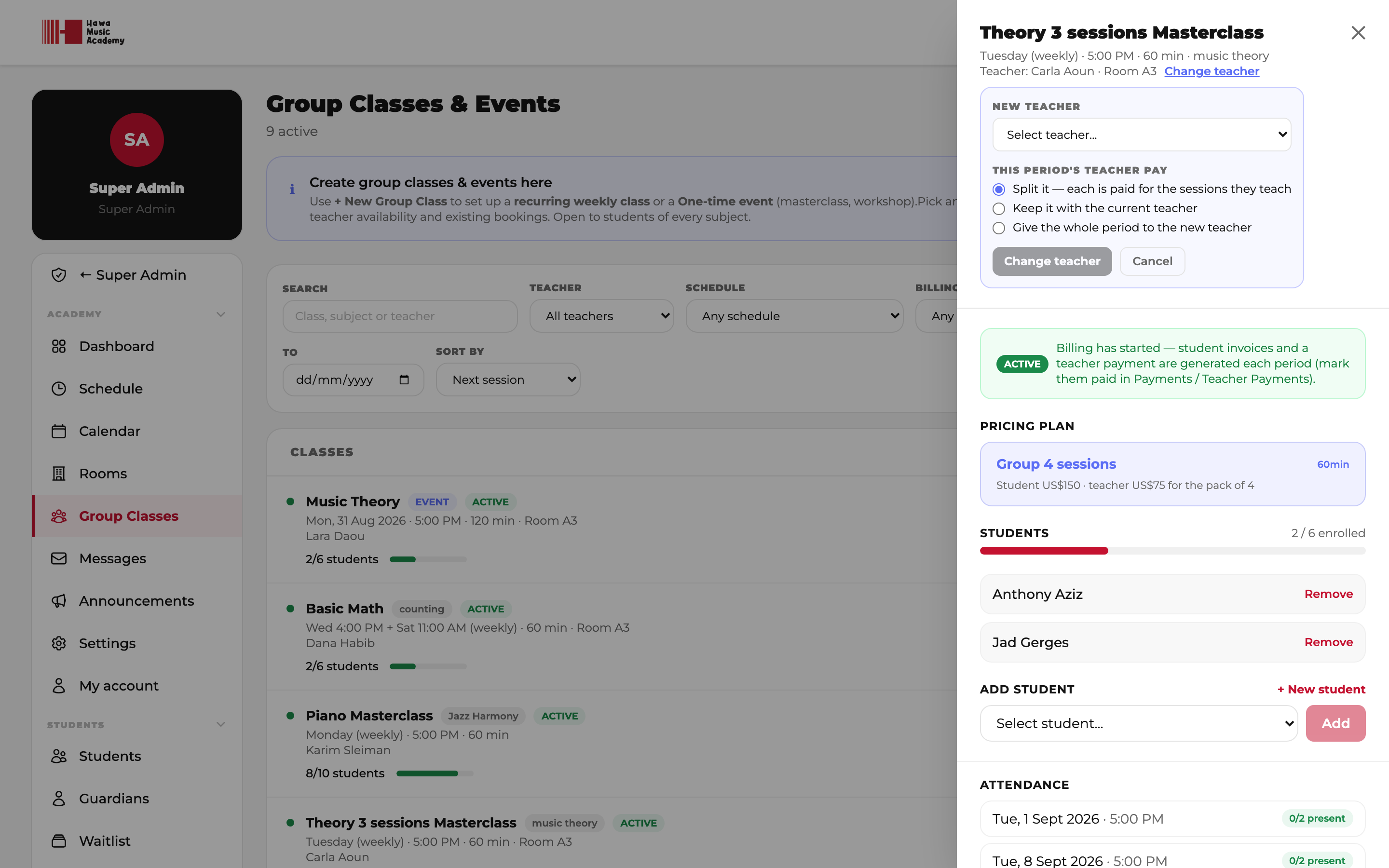
Open the class and press Change teacher. Pick the new teacher, then decide what happens to this period's teacher pay:
- Split it — each teacher is paid for the sessions they teach;
- Keep it with the current teacher;
- Give the whole period to the new teacher.
The students, register and billing stay exactly as they are — only the teacher changes — and the change is recorded in the Audit Log.
11 · Payments & promo codes
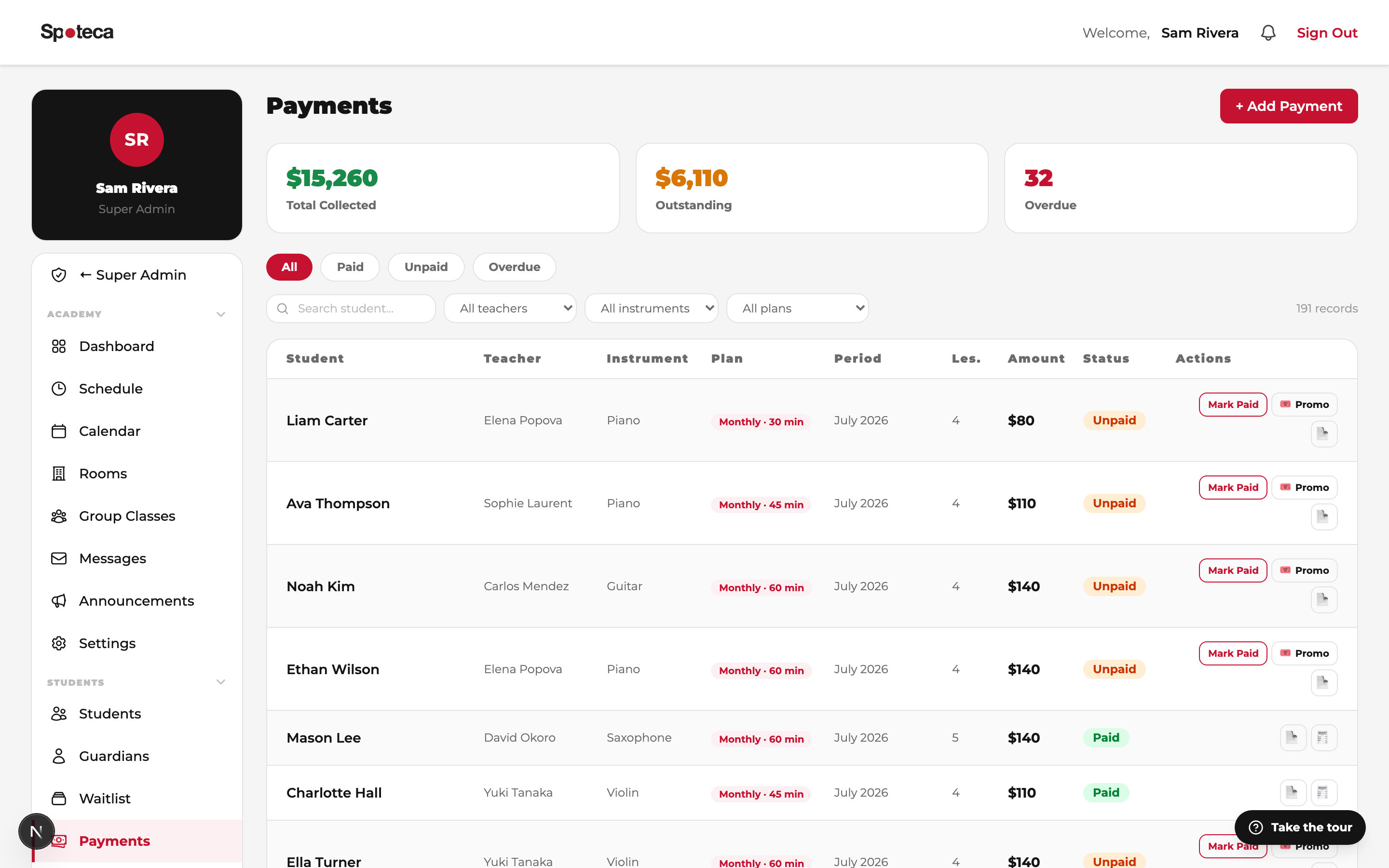
Sidebar → Money → Student Payments
- Statuses — Paid, Unpaid, Partial, Overdue, Cancelled. Overdue students are flagged automatically and can receive payment reminders.
- Documents — every payment produces a numbered invoice and, once paid, a numbered receipt (PDF, branded with your logo). Refund receipts exist too.
- Promo codes Money → Promo Codes — percentage or fixed discounts; for everyone or for the students you tick, on every plan or only the plans you tick; usage caps and expiry dates. Applied at payment time, the discount trail is kept.
- Credit — refunds issued as credit sit on the enrollment and get deducted from the next invoice.
12 · Teacher payments
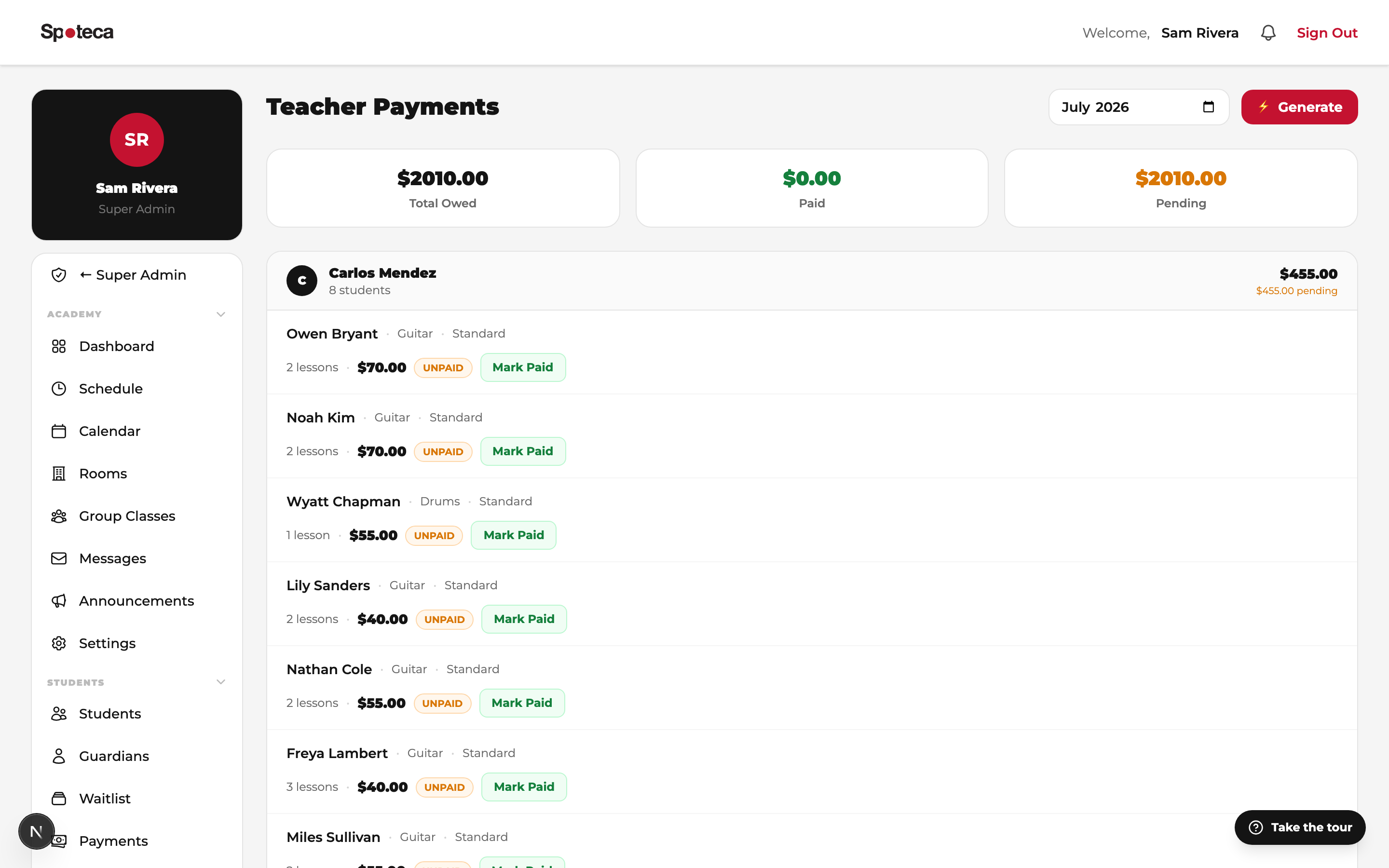
Sidebar → Money → Teacher Payments
Teacher pay is calculated automatically each month from delivered lessons × the plan's teacher rate (with per-teacher overrides where set). Plans marked pay-per-attendance count only sessions marked Present. Apply deductions with a note when needed, mark payouts as paid, and export a PDF pay statement per teacher. Teachers see the same numbers in their own portal — no more spreadsheet disputes.
13 · Attendance & lesson notes
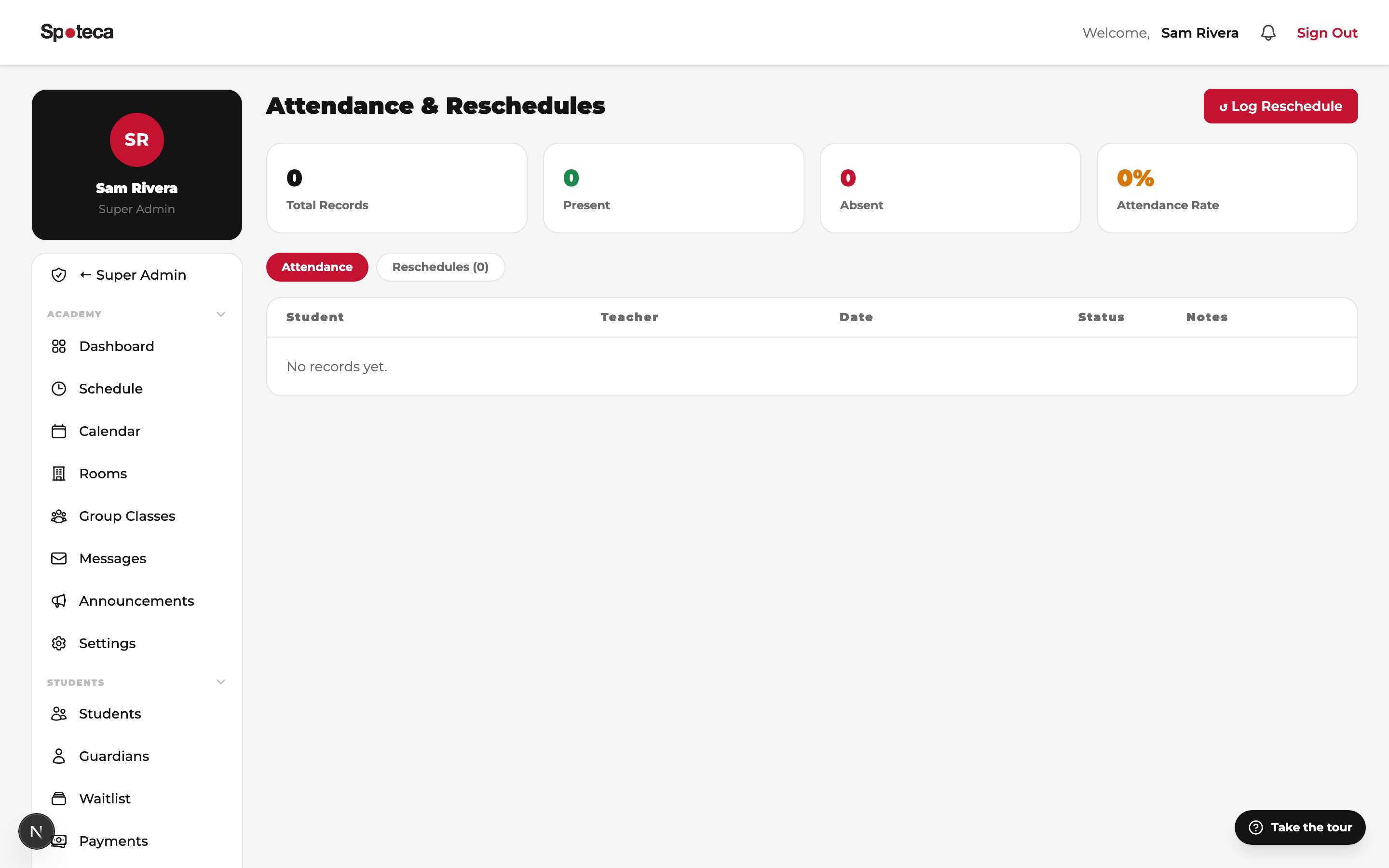
Sidebar → Calendar (admins can mark it; teachers usually do). Statuses: Present, Absent, Late, Excused. Attendance links to payments where relevant (pay-per-attendance plans) and feeds the student flags system.
Sidebar → Students → Lesson Notes gives you oversight of every note teachers write — content, homework, rating and attachments — so you always know teaching is happening and parents are getting feedback. Two tabs: Notes written, and Needs notes — every lesson marked Present in the last 90 days that still has no note, with the student, date and teacher, so you can see at a glance who is behind on write-ups. The student, teacher and date filters apply to both.
14 · Messages & announcements
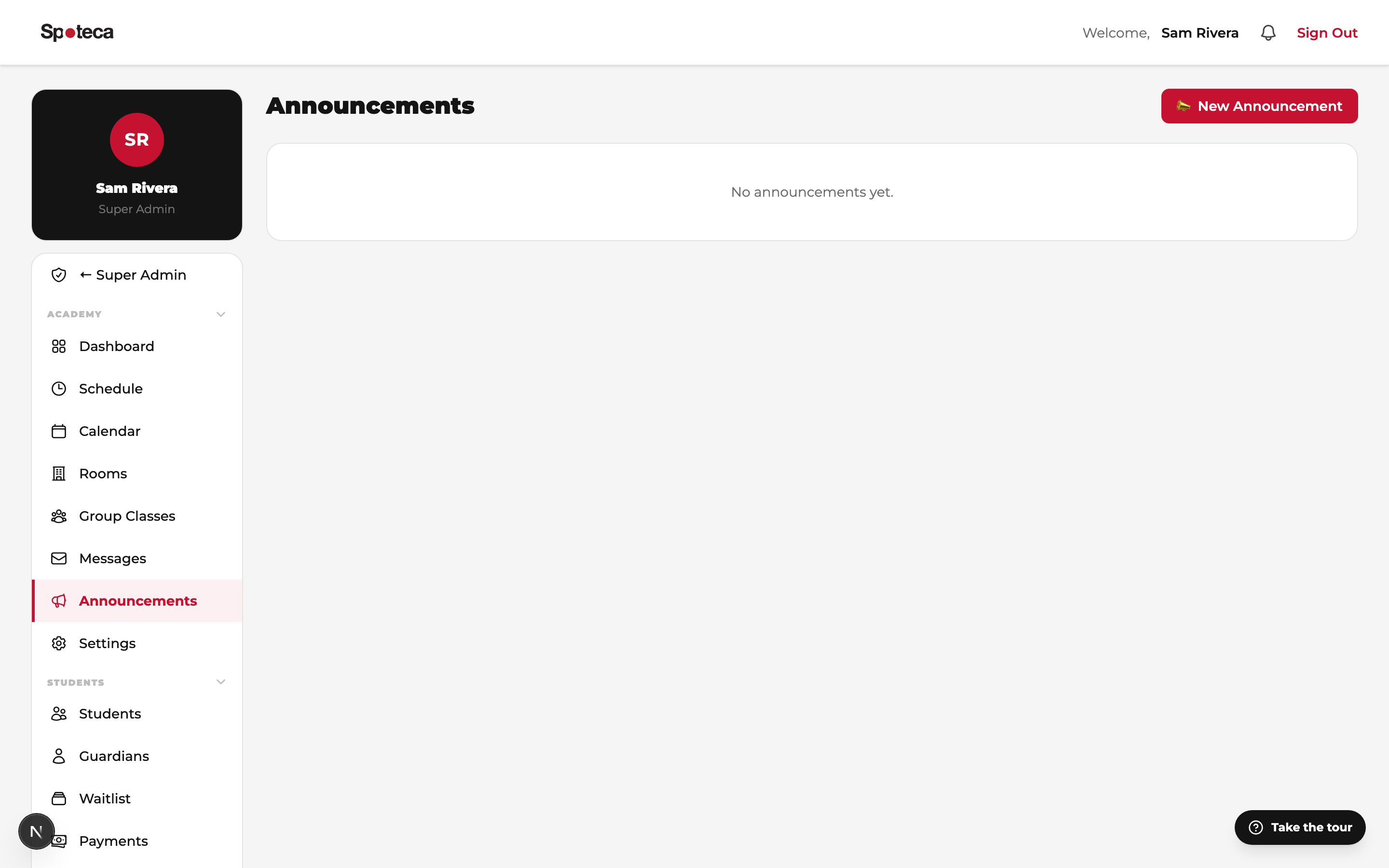
Messages Messages — direct chat with any teacher, student or guardian. Read receipts and reactions included; every conversation is logged in one place (goodbye, WhatsApp chaos).
Announcements Messages → Announcements — one-to-many broadcasts: all students, all teachers, or everyone. Ideal for holiday closures, recital invitations, policy updates. Recipients get an in-app notification (and push, if they enabled it).
15 · Waitlist, guardians & reports
- Waitlist Students → Waitlist — park people who want a place before you have one; when a slot frees up, notify and enroll in two clicks. More below.
- Guardians Students → Guardians — link parents to students. Every guardian you add gets their own parent portal login: you set their username and password on the same form as their name, so you can hand the details over straight away. If the parent already has a Spoteca account, search for it at the top of the guardian card and link it instead — their name and contact details are then read from that account.
- Reports Students → Reports — per-student progress reports and school-level summaries, exportable as branded PDFs.
- Progress Students → ⋯ More → Progress — skills, repertoire, badges, the practice goal, and Exams & assessments: record an exam before it happens and add the grade afterwards, whether your school sets it or the student sits it at their own school. Teachers can only file exams for subjects they teach that student; you can record any subject.
The waiting list
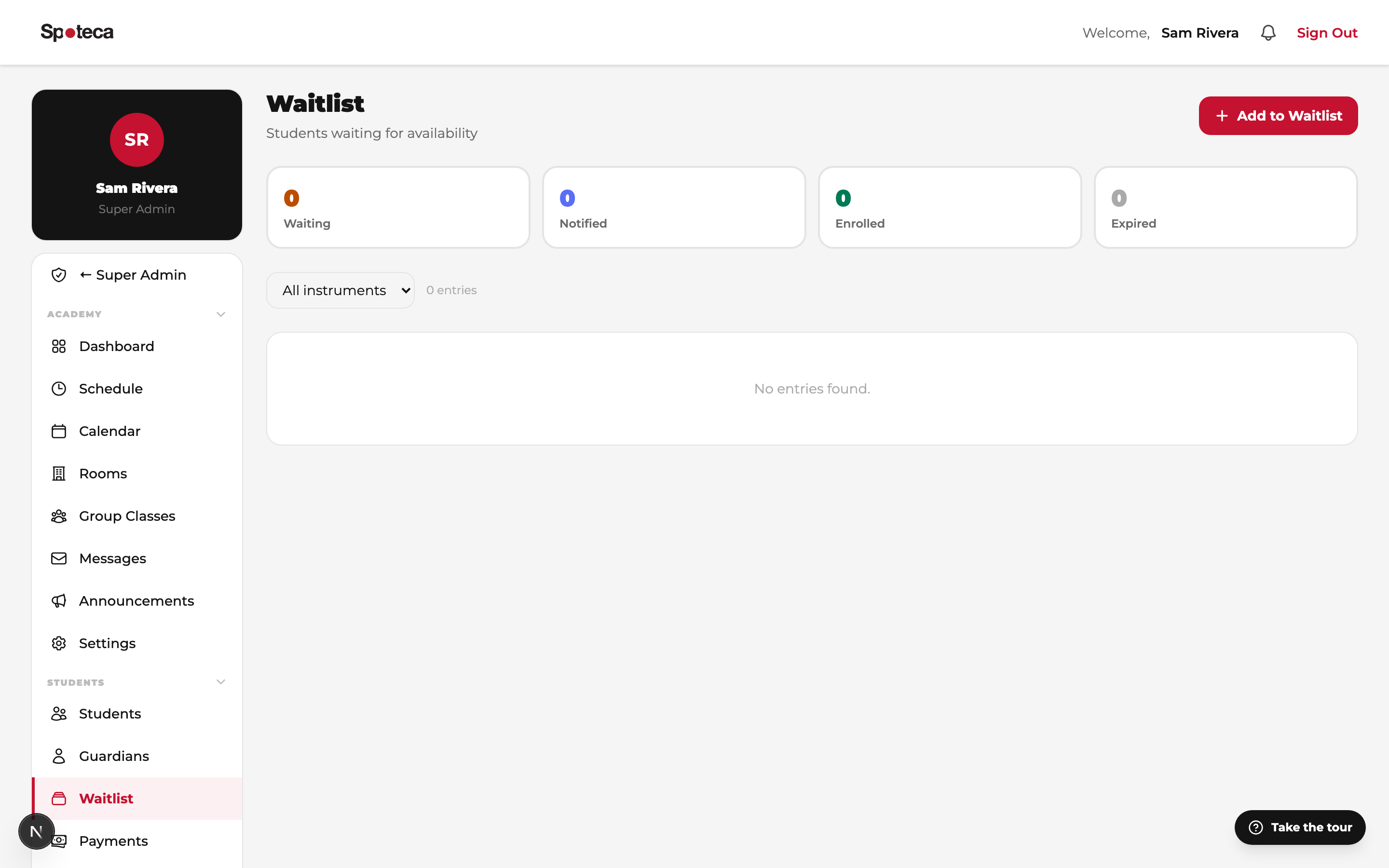
A waiting list is mostly people who are not students yet — a parent who rang on Tuesday, someone who asked after a recital. So it does not ask you to create a student record first. Press Add to Waitlist and fill in:
- Student name — required. Just type it; no account, no username, no password.
- Phone number — optional but worth having. A prospect has no Spoteca login, so a phone number is how you reach them when a place opens.
- Subject — required, chosen from your school's own subject list, the same one the teacher form and enrolment read.
- Preferred teacher, days and notes — all optional.
When a place opens, mark the entry Notified, then Enrolled once they've taken it. Entries that go cold can be marked Expired rather than deleted, so you keep the history.
16 · Your account & getting help
My account
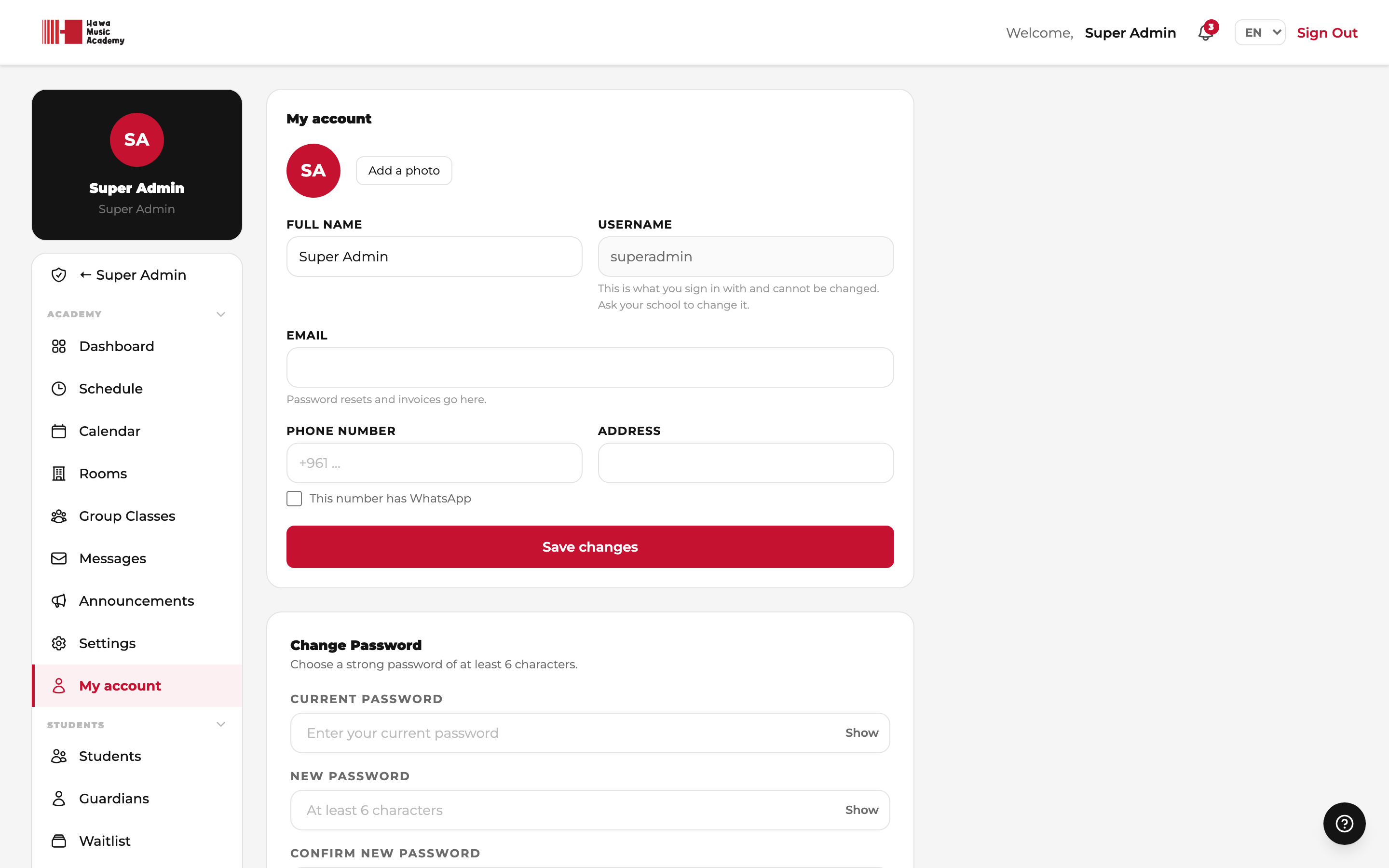
Sidebar → My account — your own name, email, phone, address and photo, and your password. Changing your email asks for your current password and sends a confirmation link to the new address; nothing changes until you click it. Your username can't be changed.
Ask AI
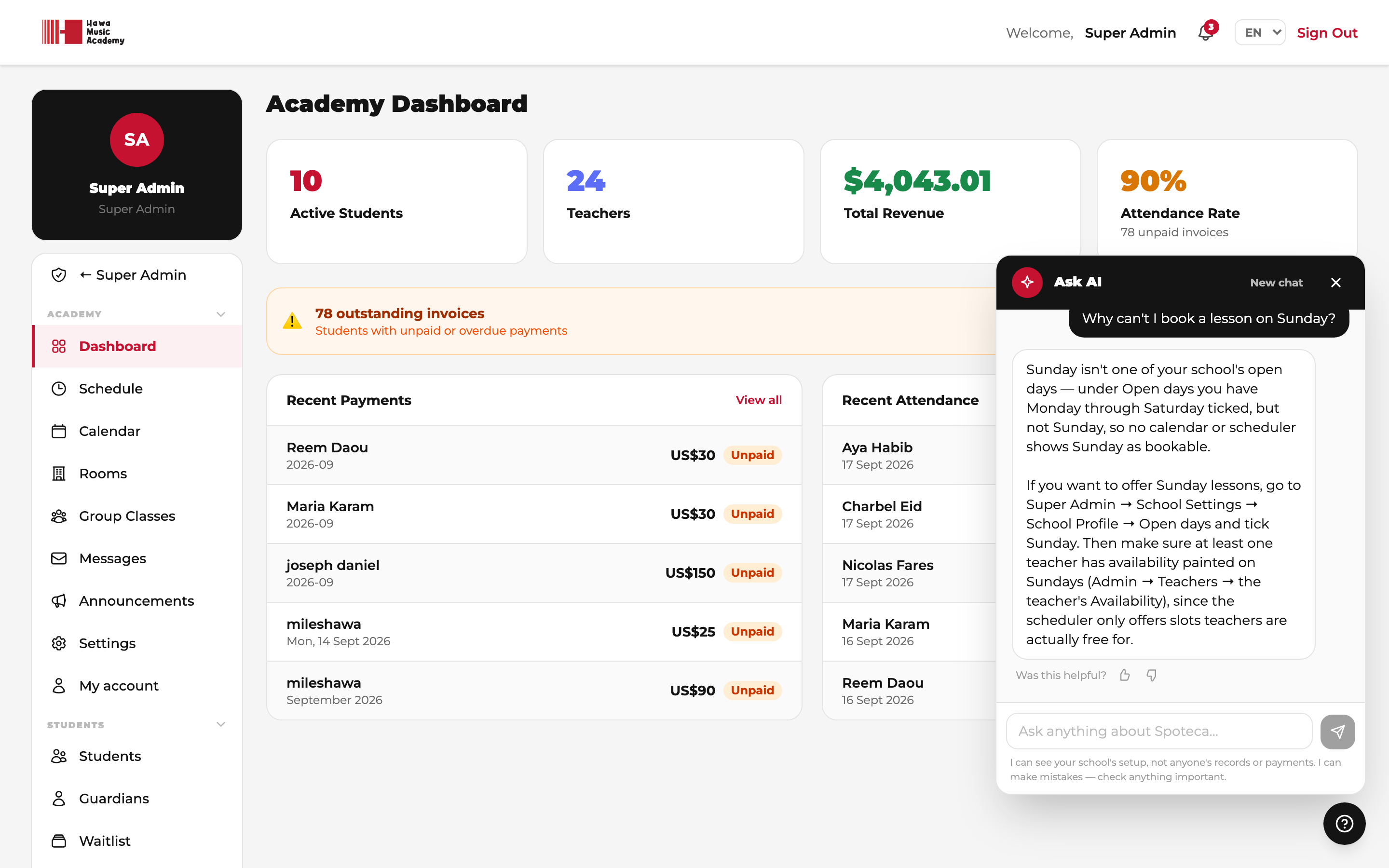
The ? button in the bottom corner opens Ask AI and this tutorial. Ask AI answers questions about using Spoteca in your language, and it can see how your school is set up — open days, teachers, plans, classes — so "why can't I book Friday?" gets an answer about your school. It can't see anyone's records or payments. Under each answer, tell us with 👍 or 👎 whether it helped — a thumbs-down reaches the Spoteca team so the answer gets fixed.
If editing is switched off
If the school's own Spoteca invoice is overdue, a banner appears at the top and changes are paused until the owner settles it. Everything stays readable and nothing is lost. Teachers, students and parents only see a note to contact the office.
FAQ
I can't pick a slot when enrolling — the list is empty.
The chosen teacher has no (remaining) availability, or the day isn't one of the school's open days. Check Section 4 — either the teacher hasn't painted their grid, or every available slot is already booked.
Can one student learn two subjects?
Yes — add a second enrollment on the same student. Each enrollment has its own teacher, slot, plan, invoices and reschedule allowance.
How do trials work?
Create a Trial pricing plan (one-time). Enroll the prospect on it; after the session, convert them to a full plan. A trial ends the day after its last session. If the trial fee is folded into the plan they chose, Cancel the trial invoice.
A parent wants to move Thursday's lesson only.
They can ask from their own Schedule page, or you move that one occurrence from the calendar — the weekly slot is untouched. A move the family asked for uses one of their monthly reschedules; one the school makes is free.
A family cancelled an hour before the lesson.
Cancel it as asked by the student or family. If the plan has a notice window and the cancel is inside it, the session counts as used — tick Waive it if you'd rather not count it.
What if a teacher leaves?
Hand each of their group classes to another teacher with Change teacher, reassign their individual students from the teacher's page, then deactivate the account. History is preserved.
Can I delete a student?
Deactivate them — that stops billing and keeps their history. Only the owner can permanently delete, and only an account that was never enrolled or invoiced.
Next → The Teacher Guide: availability, lessons, notes & pay